A Systematic Destruction

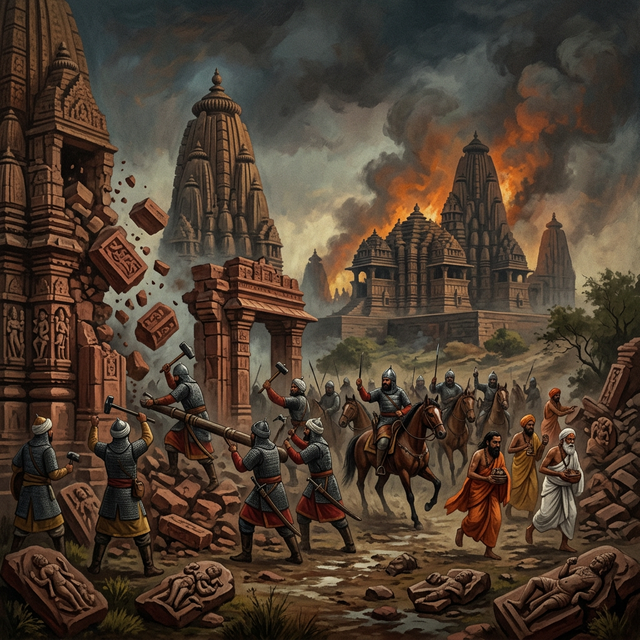
Qutbuddin Aibak's military campaigns were not random acts of war. They followed a consistent, deliberately ideological pattern: capture a city, demolish its temples and centers of learning, enslave the population, transport loot to the treasury, and build a mosque on the ruins of the most sacred site.

This pattern is documented not once but repeatedly across dozens of cities and campaigns, always by the same court historians celebrating the same "achievements." What follows are detailed accounts of each major campaign.
Delhi — The Capital Broken

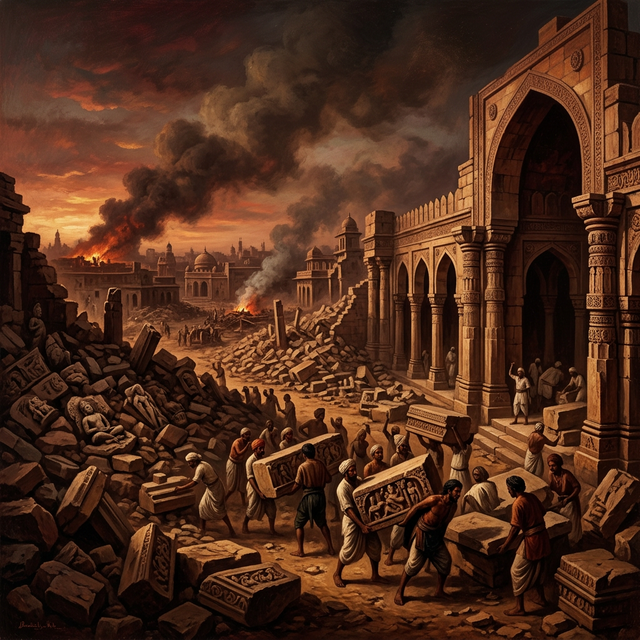
The Quwwat-ul-Islam mosque being constructed from 27 demolished Hindu and Jain temples in Delhi — historical painting showing the repurposing of sacred Hindu temple columns and materials into a mosque, with the Qutb Minar visible in the background

The Quwwat-ul-Islam Atrocity

After capturing Delhi in 1192–1193 CE, Aibak ordered the demolition of 27 Hindu and Jain temples. Their carved stone pillars, walls, and materials were directly incorporated into the Quwwat-ul-Islam mosque — the first mosque built in India.

The mosque's own Arabic foundational inscription, still legible at the Qutb Complex in Delhi, records: "This mosque was built after demolition of idol-houses, and on the foundations of demolished temples of the Hindus."

What Was Destroyed at Delhi

  • 27 major Hindu and Jain temples demolished, their materials repurposed for the Quwwat-ul-Islam mosque
  • The historic city's entire religious infrastructure systematically dismantled
  • The surviving Hindu population enslaved and subjected to jizya (non-Muslim tax)
  • Construction of the Qutb Minar begun — using enslaved Hindu craftsmen, whose traditional craftsmanship left distinctive Hindu-style stonework visible to this day
Twenty-seven temples were demolished, and on their very foundations, a mosque was raised; and the materials of the former provided material for the mosque and the pillars and carved stones of the demolished temples were pressed into service for the construction. — Foundation inscription of Quwwat-ul-Islam mosque, Delhi (1193 CE), as cited in ASI records and translated in multiple historical works
Wikipedia: Quwwat-ul-Islam →

Ajmer — Sanskrit Knowledge Burned

Ajmer, the sacred center of Rajput civilization and home to the famous Saraswati Kantha Abharana Sanskrit college — one of India's great centers of learning — was sacked in 1193 CE.

He burnt the colleges and monasteries...He burnt with naphtha the lamp of the great house of idols and levelled it to the ground; and on the very spot he built the Mosque of Two-and-a-half Days (Dhai Din Ka Jhonpra). Taj-ul-Maasir by Hasan Nizami, Aibak's court historian | Wikipedia: Dhai Din Ka Jhonpra →

The Dhai Din Ka Jhonpra — Evidence That Survives

The mosque built on the ruins of the Sanskrit college still stands in Ajmer today. Visitors can see original Sanskrit inscriptions on its interior walls — inscriptions from the original Sanskrit college, incorporated into and still visible within the mosque that replaced it. This is among the most visible physical evidence of Aibak's cultural destruction.

  • Saraswati Kantha Sanskrit college — burned with naphtha
  • Adjacent temple complex — demolished
  • Dhai Din Ka Jhonpra — built on the ruins, still standing
  • Sanskrit inscriptions — still readable inside the mosque today

Varanasi — "A Thousand Temples" Destroyed

Varanasi (Banaras/Kashi), the oldest inhabited city in the world and the most sacred city in Hinduism, was sacked following the Battle of Chandawar in 1194 CE. What followed was among the most devastating cultural destructions in Indian history.

The victory was won. A thousand temples were emptied of their idols. The idol-houses were converted into mosques. The city of Varanasi, the cradle of infidelity, was thoroughly plundered. Taj-ul-Maasir by Hasan Nizami (c. 1228 CE), describing the sack of Varanasi | Wikipedia: Qutb ud-Din Aibak →

Nizami here is celebrating these acts as religious victories. Yet these words — "a thousand temples emptied" — appear in the primary source text of Aibak's own court historian. This is not interpretation or speculation. It is the documented, celebrated reality.

The Significance of Varanasi

Varanasi was not just any city. It was the spiritual heart of Hinduism — the city of Lord Shiva, home to thousands of temples built over millennia, the center of Sanskrit scholarship, philosophy, and religious practice for all of Hindu India. Its sacking was not a military tactic — it was a deliberate strike at the civilizational soul of India.

Gujarat — India's Wealthiest Plundered

In 1195–1197 CE, Aibak led campaigns into Gujarat — then one of India's wealthiest and most culturally advanced regions. The primary target was Anhilwara (modern Patan), the capital of the Solanki Rajputs.
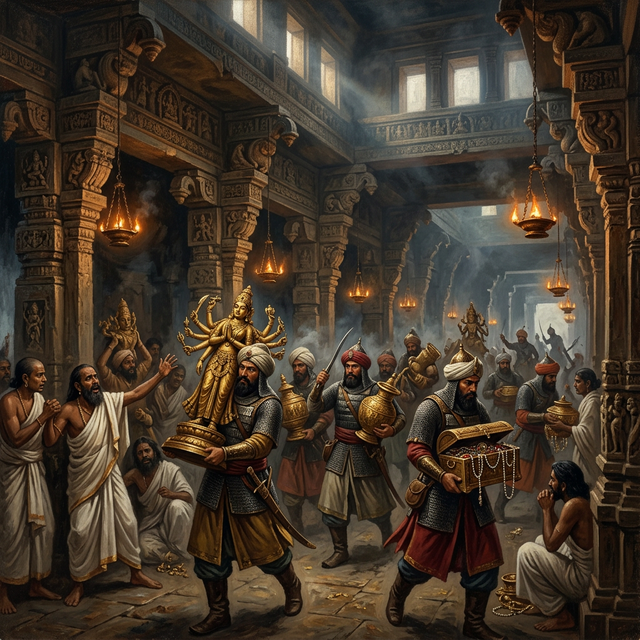
Historical painting of Qutbuddin Aibak's soldiers looting Gujarat's ancient Hindu temples, carrying gold idols, sacred treasures, and jewels from temple interiors during the sack of Anhilwara in 1195 CE

What Was Looted from Gujarat

  • Fifty thousand prisoners enslaved in Gujarat campaign alone
  • Enormous gold and silver treasures from Gujarat's wealthy temples transported to Ghori's treasury in Ghazni
  • The Solanki capital Anhilwara (Patan) comprehensively sacked
  • Temples and cultural institutions across Gujarat systematically destroyed

Ferishta records that the Gujarat campaigns yielded an "immense quantity" of gold and silver treasures which were transported back. Gujarat, which had become one of the world's great centers of commerce and culture under the Solanki dynasty, was devastated.

Nalanda — The Greatest Crime Against Knowledge

The destruction of Nalanda University in 1193 CE is arguably the single greatest act of cultural destruction in South Asian history. While Bakhtiyar Khilji physically led the attack, he operated entirely under Qutbuddin Aibak's authority as viceroy.
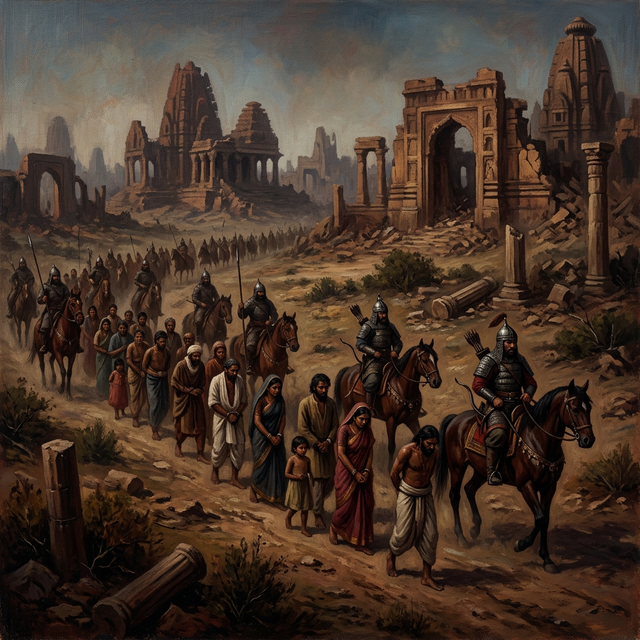
Historical painting depicting Buddhist monks fleeing the burning of Nalanda University in 1193 CE under Bakhtiyar Khilji who operated under Qutbuddin Aibak's command — one of the worst acts of cultural destruction in human history

What Was Destroyed at Nalanda

  • The world's oldest residential university (founded 5th century CE)
  • An estimated 9 million manuscripts in the library complex (Dharmaganja)
  • Hundreds of resident scholars and monks killed
  • The entire university complex set ablaze — burned for 3 months
  • Buddhism effectively ended in India
Smoke from the burning books darkened the air for three months. Among the buildings were many which were of three or four stories. The Tabaqat-i-Nasiri describes monks still living in Nalanda at the time of the attack; when Khilji's soldiers asked who were these men with shaved heads they were told they were priests, whereupon he ordered them all slain. Tabaqat-i-Nasiri by Minhaj-i-Siraj (c. 1260 CE) | Wikipedia: Nalanda →
⚠️ The End of Buddhism in India

Before Aibak's campaigns, Buddhism had thrived in India for 1,700 years — producing Nalanda, Vikramashila, and the Ajanta-Ellora traditions. Within decades of his campaigns' destruction of Buddhist monasteries, universities, and communities, Buddhism had effectively vanished from the land of its birth. Today, India has among the lowest Buddhist populations despite being Buddhism's birthplace — a direct consequence of Aibak's campaigns.

Next Chapter

Religious Persecution →

The documented pattern of forced conversions, mass enslavement, and the deliberate erasure of Hindu and Buddhist religious identity.