Chapter 7
Legacy & Modern Impact
Aibak's destruction did not end in 1210 CE. It echoes through every contested mosque, every missing temple, and every gap in India's historical memory.
Aibak's destruction did not end in 1210 CE. It echoes through every contested mosque, every missing temple, and every gap in India's historical memory.
The consequences of Qutbuddin Aibak's campaigns are not confined to medieval history. They live in the physical landscape of modern India, in contemporary legal battles over mosques built on temple ruins, in the absence of Buddhism from the land of its birth, in the missing chapters of India's educational curriculum, and in the ongoing debates over India's historical identity.
When Indians argue today about what should be taught in history textbooks, whether the Qutb Minar and Quwwat-ul-Islam's origin should be acknowledged, or whether disputed religious sites have historical Hindu claims — they are arguing about the living consequences of decisions made by Qutbuddin Aibak 830 years ago.
The Qutb Minar complex in Delhi — today a UNESCO World Heritage Site visited by millions annually — is one of Aibak's most visible legacies. UNESCO describes it as: "The Qutb Minar and its monuments, is one of the finest towers in the world and a major landmark of Islamic architecture in India."
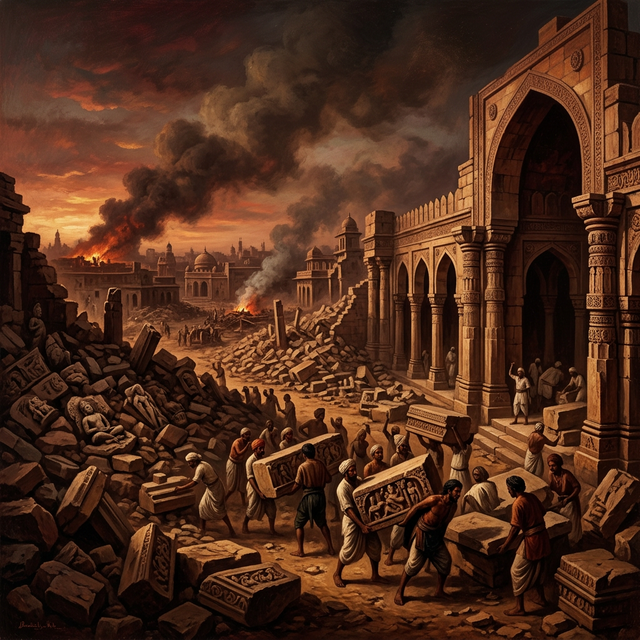
In 2022, a petition was filed in a Delhi court claiming that the Qutb Minar complex contains Hindu and Jain idols and was built on demolished temples, seeking permission for Hindu worship. The Archaeological Survey of India (ASI) confirmed that the complex was built using materials from demolished temples. The court case brought India's historical memory into direct contemporary legal relevance.
The Dhai Din Ka Jhonpra mosque in Ajmer is one of the most extraordinary physical legacies of Qutbuddin Aibak's campaign. Built on the site of the burned Saraswati Kantha Sanskrit college in 1193 CE, it still stands today.
The Ajmer Dargah — India's most visited Muslim pilgrimage site — is in the same city. Every year, millions of Hindus visit it seeking blessings. The irony is profound: the same city they visit to pray also contains a mosque built by burning the school of their ancestors — and most visitors have no idea.
Qutbuddin Aibak's most consequential legacy is the institution he founded: the Delhi Sultanate. As the first Sultan of Delhi, he established the Mamluk dynasty (1206–1290 CE), which was succeeded by four more dynasties — Khalji, Tughlaq, Sayyid, and Lodi — lasting until 1526 CE.
The Delhi Sultanate, which Aibak founded, governed most of northern India for 320 years. The destructive pattern he established — temple demolition, jizya tax, religious persecution — was continued, expanded, and institutionalized by his successors. Iltutmish, Alauddin Khalji, Firoz Shah Tughlaq, Sikandar Lodi — all followed the template of destruction that Aibak laid down.
India's history education continues to present a sanitized version of medieval history that serves political rather than historical purposes. A democracy requires citizens to know their history accurately — including its painful chapters. The cure for historical pain is not historical amnesia.
Every Indian has the right to visit the Qutb Complex and be told by the Archaeological Survey of India's information boards the full truth: that the mosque was built from 27 demolished temples, that the columns contain original Hindu and Jain carvings, and that the entire complex was constructed on India's broken sacred heritage. This is not incitement — it is factual historical disclosure.
India's government has invested significantly in promoting Buddhist tourism and diplomacy. This is commendable. But no serious engagement with Buddhism's return to India is possible without acknowledging why it left — and Qutbuddin Aibak's role in its extermination from the subcontinent.
Dozens of legal cases currently in India's courts concern mosques built on disputed temple sites — from Ayodhya (settled in 2019) to Mathura, Varanasi, and others. Many of these disputes trace to the Delhi Sultanate period that Aibak inaugurated. Understanding Aibak's documented acts is essential context for understanding these contemporary legal and social conflicts.