Chapter 6
The Damage Quantified
Numbers that put the scale of destruction into perspective — temples, manuscripts, people, and wealth.
Numbers that put the scale of destruction into perspective — temples, manuscripts, people, and wealth.
The following estimates are drawn from primary medieval chronicles, archaeological evidence, and scholarly economic history. Where primary sources give specific numbers (e.g., "27 temples," "50,000 prisoners," "a thousand temples"), those figures are used directly. Where estimates are required, they are derived from scholarly consensus and noted as such. All sources are cited.
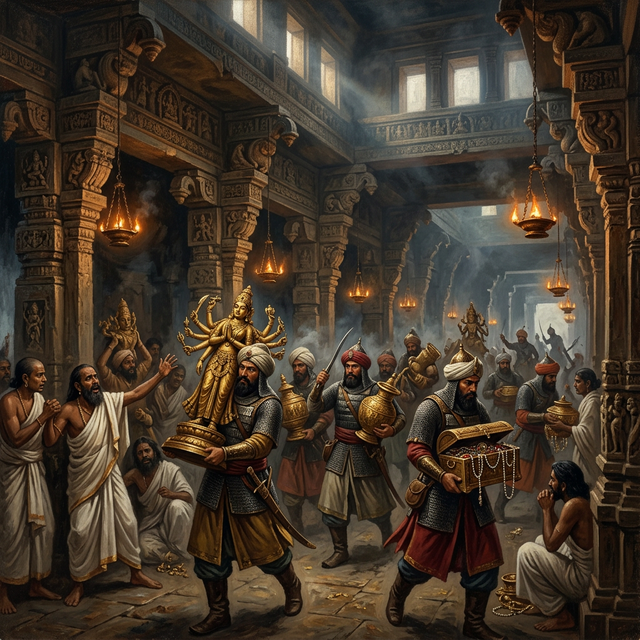
The primary sources document specific temple destruction in specific locations. Not all destructions were recorded — what we have in the chronicles represents only the highlights that the court historians chose to celebrate as religious achievements.
Historian Sita Ram Goel in Hindu Temples: What Happened to Them (1990) compiled the most comprehensive survey of temple destructions across the Sultanate period, working from primary Islamic chronicles. His estimate for temples destroyed or converted during Aibak's era (as viceroy and Sultan) runs into the thousands across northern India.
India in 1200 CE was estimated to have held approximately 25% of global GDP. By 1700 CE — after five centuries of Sultanate and Mughal rule — this had fallen to approximately 24.4% of global GDP (still significant). But the internal distribution had been radically altered: wealth had been systematically extracted from India's temple economies and redistributed to the conquerors' treasuries.
Hindu and Buddhist temples in medieval India were not merely places of worship. They were:
When Aibak demolished a temple and extracted its treasury, he was not merely removing a religious building. He was destroying an economic institution that sustained entire communities.
Economic historian Angus Maddison in The Contours of the World Economy 1-2030 AD provides the most cited data on India's historic share of global GDP:
The long-term economic damage of the Sultanate period is debated among historians. What is clear is that the systematic extraction of temple treasuries, the destruction of trade networks, and the disruption of the agricultural temple economy had significant long-term consequences for India's economic capacity.
The burning of Nalanda University's library — with its estimated 9 million manuscripts — represents the single greatest loss of recorded human knowledge in history. To put this in context:
Indian mathematicians in the 5th century CE had discovered the decimal number system, the concept of zero (Aryabhatta, 499 CE), and were working on what we now call trigonometry and calculus. We know this because some manuscripts survived in other locations. We do not know what was in the manuscripts that burned at Nalanda. The question "what would India — and the world — have discovered without this destruction?" is unanswerable. And that is perhaps the most devastating legacy.