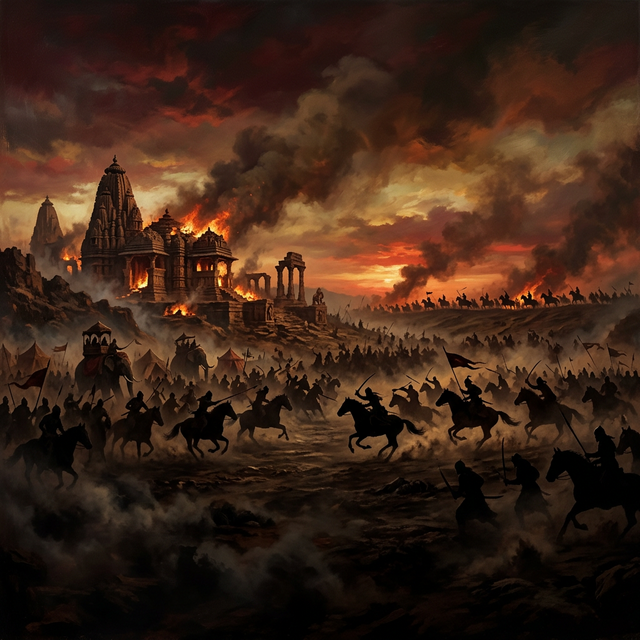
18 Years of Documented Destruction

Qutbuddin Aibak's engagement with India spans from 1192 CE — when he arrived as Muhammad Ghori's viceroy following the Second Battle of Tarain — to 1210 CE, when he died in Lahore. During this time, he was responsible for or directly supervised some of the most consequential cultural destructions in Indian history.

The following timeline is compiled from the primary medieval chronicles: the Taj-ul-Maasir of Hasan Nizami, the Tabaqat-i-Nasiri of Minhaj-i-Siraj, and the Tarikh-i-Ferishta of Muhammad Qasim Hindu Shah.

1192 CE
Second Battle of Tarain — India Falls
Muhammad Ghori defeats Prithviraj Chauhan at the Second Battle of Tarain. Qutbuddin Aibak commands a critical cavalry wing in this decisive battle. Prithviraj is captured and subsequently executed. Aibak is appointed viceroy of the conquered territories.

Source: Tabaqat-i-Nasiri by Minhaj-i-Siraj (c. 1260 CE) | Wikipedia →
1192–1193 CE
Delhi Captured — 27 Temples Demolished
Aibak captures Delhi and immediately orders the demolition of 27 Hindu and Jain temples. Their materials are used to construct the Quwwat-ul-Islam ("Might of Islam") mosque — the first mosque built in India after the conquest. The mosque's own foundational inscription records this fact in Arabic, still readable today.

Source: Taj-ul-Maasir by Hasan Nizami, Quwwat-ul-Islam mosque inscription | Wikipedia →
1193 CE
Ajmer Sacked — Sanskrit College Burned
Aibak sacks Ajmer, the sacred city of the Chahamana Rajputs. He orders the burning of the Saraswati Kantha Abharana Sanskrit college and its library. On its demolished site, he builds the Dhai Din Ka Jhonpra mosque, still standing today with original Sanskrit inscriptions visible on its interior walls.

Source: Taj-ul-Maasir by Hasan Nizami | Wikipedia →
1193 CE
Nalanda Destroyed — The Greatest Cultural Crime
Aibak dispatches his general Bakhtiyar Khilji to Bihar. Khilji attacks Nalanda University — the world's oldest residential university (founded 5th century CE), which held an estimated 9 million manuscripts. The library complex burns for three months. Thousands of Buddhist monks are killed, mistaken for "shaved-headed Brahmin priests." Buddhism in India effectively ends.

Source: Tabaqat-i-Nasiri: "smoke darkened the air for three months" | Wikipedia →
1194 CE
Varanasi Sacked — "A Thousand Temples" Destroyed
Following the Battle of Chandawar, Aibak's forces sack Varanasi (Banaras), the most sacred city in Hinduism. Hasan Nizami records in the Taj-ul-Maasir that "a thousand temples were emptied of their idols" and mosques were established in their place. An estimated 1,000+ temples are destroyed or converted.

Source: Taj-ul-Maasir by Hasan Nizami | Wikipedia →
1195–1197 CE
Gujarat Campaign — Anhilwara (Patan) Plundered
Aibak leads multiple campaigns into Gujarat, sacking Anhilwara (modern Patan), then one of India's wealthiest cities. The looting is described in detail by Ferishta — enormous quantities of gold, jewels, and sacred temple treasures are transported to Ghori's treasury in Ghazni. Temples across Gujarat are demolished and mosques established.

Source: Tarikh-i-Ferishta | Wikipedia →
1197–1200 CE
Bikramashila & Odantapuri Universities Destroyed
Under Aibak's command and supervision, Bakhtiyar Khilji extends his Bihar campaigns to destroy the Buddhist universities of Vikramashila and Odantapuri. These, along with Nalanda, were the three great centers of Buddhist learning in India. Their destruction effectively eradicates Buddhism from its Indian homeland.

Source: Tabaqat-i-Nasiri, ASI archaeological excavations | Wikipedia →
1202 CE
Gwalior Fort Captured
Aibak captures the impregnable Gwalior Fort after a prolonged siege. The temples within the fort complex are destroyed and a mosque is established. The city of Gwalior, one of the great centers of Rajput civilization, is brought under Sultanate control.

Source: Tarikh-i-Ferishta | Wikipedia →
1192–1206 CE
Systematic Enslavement of Hindus
Throughout his tenure as viceroy, after every major battle and city capture, Aibak systematically enslaves the surviving Hindu population. Historian K.S. Lal in Muslim Slave System in Medieval India documents how hundreds of thousands of enslaved Hindus were transported to Central Asian slave markets. This free labor funded the construction of mosques and the Qutb Minar.

Source: K.S. Lal, Muslim Slave System in Medieval India (1994)
1206 CE
Muhammad Ghori Dies — Aibak Becomes Sultan
Muhammad Ghori is assassinated in 1206 CE. Qutbuddin Aibak declares himself the first Sultan of Delhi, founding the Mamluk (Slave) Dynasty — the first of the five dynasties of the Delhi Sultanate. He is the first "free" Muslim ruler of an independent Indian territory.

Source: All major chronicles | Wikipedia →
1206–1210 CE
Four Years as Sultan — Consolidation of Destruction
As Sultan, Aibak continues to consolidate control across northern India. He begins the construction of the Qutb Minar — using enslaved Hindu craftsmen and materials from demolished temples. His reign is cut short when he dies in 1210 CE, reportedly from a fall during a polo match in Lahore.

Source: Tabaqat-i-Nasiri | Wikipedia →

The Net Result

In 18 years — 14 as viceroy and 4 as Sultan — Qutbuddin Aibak oversaw the systematic dismantling of northern India's civilizational infrastructure:

  • The three great Buddhist universities of India (Nalanda, Vikramashila, Odantapuri) — destroyed
  • Thousands of Hindu and Jain temples across Delhi, Ajmer, Varanasi, Gwalior, Gujarat — demolished
  • India's most sacred cities — plundered and subjugated
  • Hundreds of thousands of Hindus — enslaved
  • Buddhism — effectively extinguished from the land of its birth
  • The Delhi Sultanate — established on the ruins of Indian civilization

This is the historical record. It is documented by the conquerors' own court historians. It is confirmed by physical evidence visible today. It is absent from most Indian textbooks.

Next Chapter

Invasions & Conquests →

Detailed accounts of each city sacked and plundered by Qutbuddin Aibak.