What your textbooks never fully taught you. A comprehensive, source-backed chronicle of the first slave-king of Delhi — his temple destructions, mass enslavement, the obliteration of Nalanda, the founding of a dynasty on demolished sacred sites, and how his legacy still shapes India today.
Documented by medieval historians, archaeological surveys, and primary chronicles — the staggering scale of Qutbuddin Aibak's systematic destruction of India's civilization.
Navigate through each chapter to uncover the layers of truth that have been systematically hidden, whitewashed, or overlooked in mainstream education.
How Indian textbooks have portrayed Qutbuddin Aibak as a "great administrator" and "founder of the Delhi Sultanate" while systematically omitting his documented plunder, destruction, and mass persecution of Indian civilization.
Uncover the truth →An interactive, year-by-year account of Qutbuddin Aibak's campaigns through India — from his arrival as Ghori's slave-general in 1192 CE to his death in 1210 CE.
Walk through time →Detailed accounts of specific campaigns — the sacking of Delhi, Ajmer, Varanasi, Gwalior, Anhilwara (Gujarat), and how each city was stripped of its heritage.
See the evidence →Forced conversions. Mass enslavement. Idol-breaking as state policy. The deliberate destruction of Sanskrit learning, temples, and the complete eradication of Buddhism from India's heartland.
Read the accounts →Beyond temples — how Aibak's campaigns destroyed Nalanda University, Sanskrit colleges, Buddhist monasteries, artistic traditions, and centuries of accumulated knowledge.
Understand the loss →Numbers, statistics, and economic data that put the scale of destruction into perspective — wealth looted, temples destroyed, populations enslaved, knowledge lost forever.
See the numbers →How Aibak's rule echoes today — the Qutb Minar controversy, the Dhai Din Ka Jhonpra, the Quwwat-ul-Islam, and the civilizational wound that remains unacknowledged.
Connect past to present →Every claim is backed by primary sources — Taj-ul-Maasir, Tabaqat-i-Nasiri, Tarikh-i-Ferishta. Explore the complete bibliography with verification links.
Verify the sources →Why this website exists, our methodology for historical research, our commitment to accuracy, and how you can contribute to this educational initiative.
Learn more →The Dhai Din Ka Jhonpra mosque in Ajmer — built by Qutbuddin Aibak on the ruins of a Sanskrit college and temple — still stands today as a living monument of this erasure. The Quwwat-ul-Islam mosque in Delhi was built using material from 27 demolished Hindu and Jain temples. The Qutb Minar — a UNESCO World Heritage Site — was built by enslaved Hindu craftsmen using materials from broken sacred sites. These are not ancient controversies — they are physical structures that every Indian can visit. Understanding who built them and why is fundamental to understanding India's civilizational history.
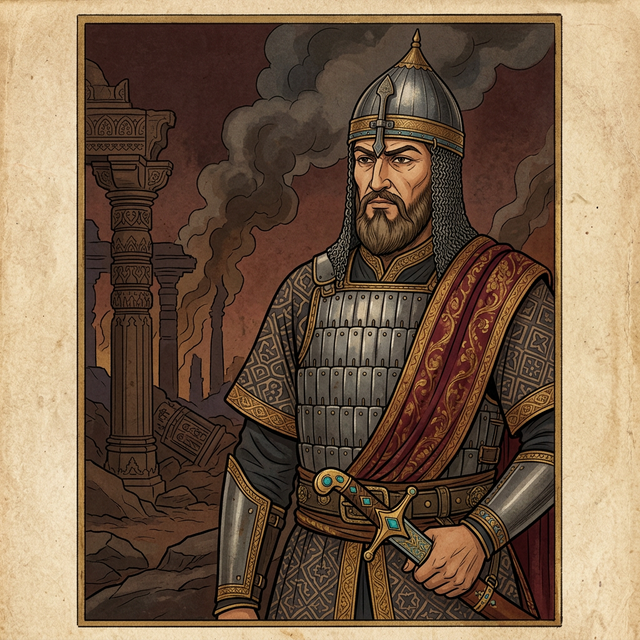
Born in Central Asia and sold into slavery as a child, Qutbuddin Aibak rose through Muhammad Ghori's court to become his most loyal and ruthless viceroy in India. His title "Aibak" literally means "lord of the moon" in Turkic, but his legacy in India was one of systematic destruction rather than enlightenment.
For nearly two decades (1192–1206 CE), before becoming Sultan, he served as Ghori's general in India — personally overseeing the destruction of every major Hindu and Buddhist center in northern India. When Ghori died in 1206 CE, Aibak declared himself Sultan, founding the Mamluk (Slave) Dynasty.
His byname was "Quran Khan" — beloved of the Quran — and he justified each act of destruction as religious duty. His own court historian celebrated these acts as achievements. Yet textbooks present him as a "great builder" of medieval India.
Read the Full Story →One version lives in textbooks. The other is documented in primary historical sources written by medieval chroniclers — many of them his own court historians.
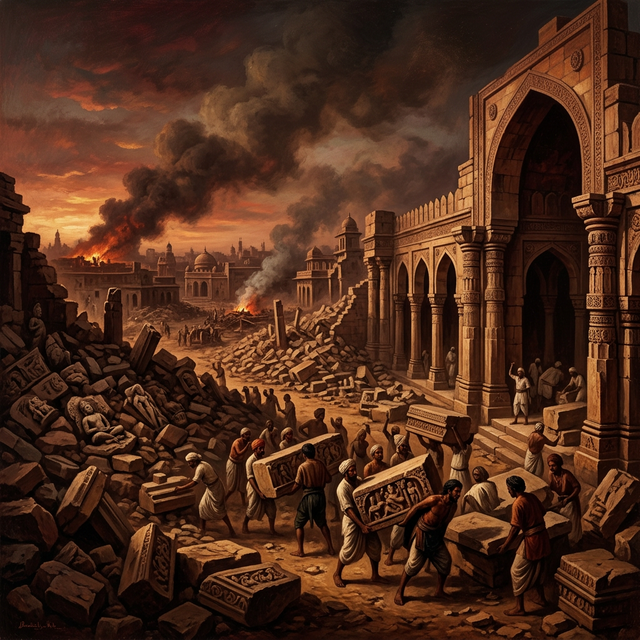
In 1193 CE, Qutbuddin Aibak ordered the demolition of 27 Hindu and Jain temples in Delhi. Their sacred stones, carved columns, and temple materials were directly repurposed to construct the Quwwat-ul-Islam ("The Might of Islam") mosque — the first mosque built in India after the conquest.
This is not propaganda. The mosque's own foundational Arabic inscription, still legible today, records that it was constructed on the site of and from the materials of demolished temples. The Hindu and Jain carvings on the repurposed columns — bells, faces of deities, garlands, chains — are visible to every visitor.
The complex is now a UNESCO World Heritage Site. Millions of Indians and tourists visit it annually. Yet most have no idea they are walking through the physical monument of one of the most deliberate acts of cultural erasure in Indian history.
Read Full Account →
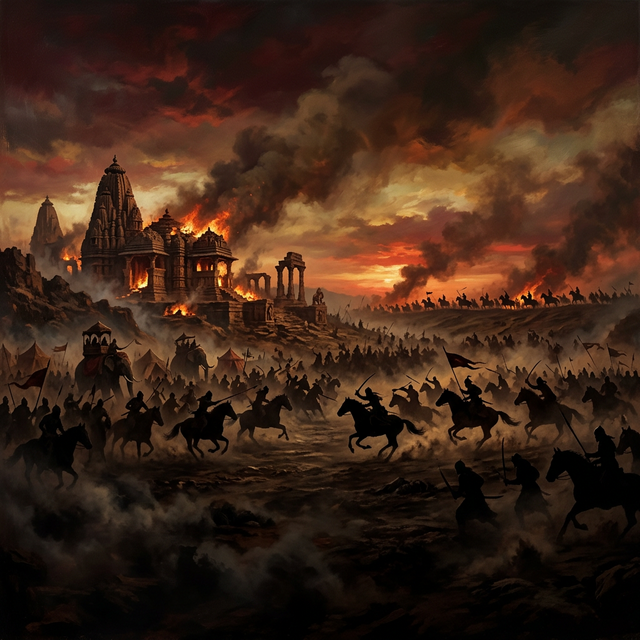
This website exists because every Indian has the right to know their true history. Every claim is backed by primary historical sources. Every fact is verifiable. Begin your journey through the chapters that textbooks left out.
Qutbuddin Aibak is one chapter. The full history of India's subjugation is documented across these comprehensive educational resources — all part of the Bharat Files Initiative.
Aibak's master — who conquered India, destroyed Nalanda, and defeated Prithviraj Chauhan before installing Aibak as his viceroy.
Visit muhammadnaghori.com →The Ghaznavid sultan who raided India 17 times, destroyed Somnath, and looted trillions in today's value.
Visit mahmudofghazni.com →The Mughal emperor who reimposed Jizya, destroyed thousands of temples and waged systematic religious war.
Visit aurangezebalamgir.com →